
11 No-Print Friendsgiving Games to Play at the Dinner Table
The turkey's resting, the wine's down to its last pour, and the conversation is circling the drain. Every Friendsgiving hits this exact pocket — plates half-cleared, nobody ready to stand up, someone scrolling under the table. These 11 friendsgiving games were built for that moment: no supplies, no printing, nobody leaves their chair.
When should you play each game during the night?
Think of the evening in three acts and match the game to the energy. Appetizers get the easy icebreakers — everyone's still arriving and the mix is uneven. The main course gets the loud, opinionated games, because people can shout between bites. Dessert gets the mellow wind-downs, when nobody wants to think hard. The most common mistake each year: saving the high-energy games for the end, when half the table is already in a food coma. Front-load the noise.
(If the menu's still coming together, these easy Halloween party appetizers double as solid fall-gathering starters — the seasonal overlap is doing you favors.)
The 11 games
1. Two Truths and a Thanksgiving Lie
The classic earns its spot — zero setup, and it gets strangers talking in about ninety seconds. Everyone takes a turn sharing three statements about themselves, one of them a lie, and the table votes on which is fake. The holiday twist: at least one statement has to involve food, family holidays, or a cooking disaster. That single constraint changes everything. "I once set a dinner roll on fire" is suddenly in play, and half your table has a story just as bad. Four to twelve people is the sweet spot; beyond that, split into halves so nobody checks out. Scoring stays simple: one point for every lie you catch, one for every person you fool.
2. Would You Rather: Holiday Edition
Somebody asks, everybody answers, no wrong answers. The trick is keeping the questions food-and-holiday specific and slightly unhinged: eat nothing but stuffing for a week, or give up pie forever? Host Friendsgiving every year, or never cook again? This is a main-course game — people can answer between bites and nobody has to think too hard. Fifteen to twenty minutes is plenty; it dies the moment the questions start repeating. No scoring needed — though an unofficial "worst take of the night" award has a way of becoming a running joke.

3. Most Likely To
One person reads a prompt — "most likely to show up with a store-bought pie and claim they made it" — and on the count of three, everyone points at the guiltiest-looking friend. It's fast, it's loud, and it wants six to fourteen people who actually know each other. Rounds run about fifteen minutes, or until the prompts run dry. Scoring takes care of itself: whoever collects the most pointed fingers wins the title, and it follows them to next year's Friendsgiving. Fair warning — skip this one if half the table met an hour ago. Being singled out by near-strangers doesn't feel playful. It feels judged, and you'll feel the room tighten.
4. The One-Word Story
Go around the table, each person adds exactly one word, and together you build a story. Start it with "The turkey…" and watch it derail by word six. This is a dessert game — low energy, high laughter — and it gives the quiet people a way in without putting them on the spot. Four to ten players keeps the story coherent enough to follow; more than that and you lose the thread entirely, which is honestly half the fun. Play until the story collapses into nonsense, usually around ten minutes. No winner. The story is the point.

5. The Secret Ingredient
Pick one dish already on the table — the mashed potatoes, the gravy, whatever looks innocent. One person closes their eyes (or steps into the hallway for thirty seconds) while everyone else agrees on a fake "secret ingredient" hiding in that dish. It has to be plausible but wrong: "there's nutmeg in the gravy" when there absolutely isn't. The guesser returns and asks yes-or-no questions to crack it. Six or more players works; fewer than that and it's too easy to read faces. Five minutes per guesser, two or three rounds, and fewest questions wins. Run it before dessert, while the food is still the main character.
6. Dinner Table Hot Takes
Everyone states one food hot take — canned cranberry sauce beats homemade, pumpkin pie is overrated, mac and cheese belongs on the Thanksgiving table — and the table debates it. Defenders and attackers get thirty seconds each, then a show-of-hands vote on whether the take stands. This is main-course energy: loud, opinionated, and everybody's already got a plate so nobody's hangry. Give it twenty minutes, then cut it off before someone takes the stuffing discourse personally. The winning take is the one with the most defenders. Skip it only if your group argues for real. You know your people.

7. Whisper Down the Lane
One person whispers a phrase to their neighbor, it travels around the table, and the last person says it out loud. Start with something like "the gravy boat sailed at seven" and compare what comes out the other end. It needs at least six people to be worth it, and it's best played late — after dessert, when everyone's drowsy and mishearing things is at its funniest. Three rounds, five minutes each. No score, no stakes. The only rule: if you laugh mid-whisper, you keep going anyway.
8. Hum That Tune
Have one volunteer hum a song — no words, no drumming the rhythm on the table — and everyone else shouts guesses. Holiday songs are the obvious pick, but anything goes; the worse the humming, the better the game. Five or more players, ten to fifteen minutes, and it slots into any lull in the evening. Scoring that actually works with zero supplies: one point for the guesser, one point for the hummer if somebody nails it within thirty seconds. Keep the tally in your head. You've got no supplies, and that's the whole point.
9. The Alphabet Conversation
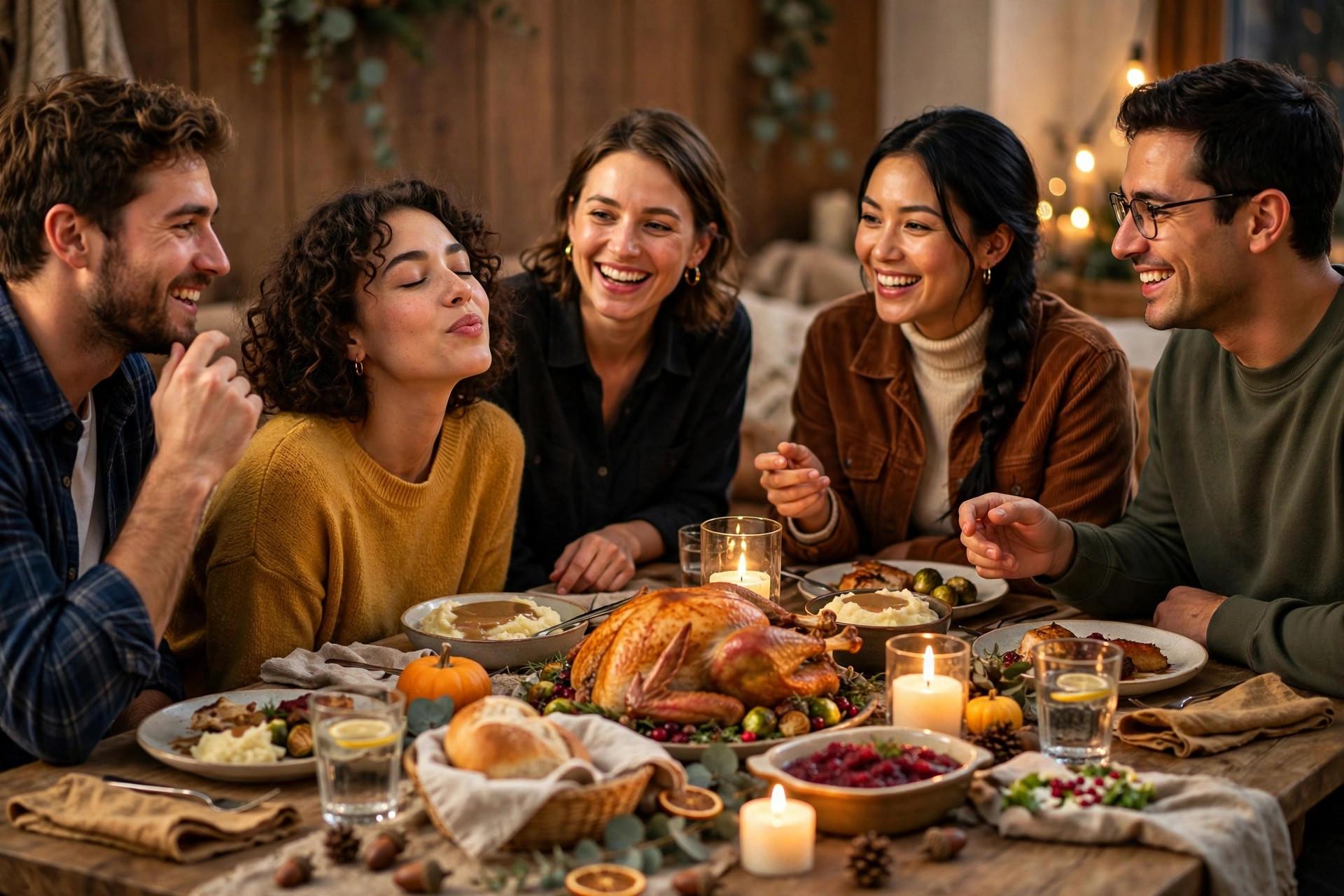
Hold a normal conversation, except each person's sentence has to start with the next letter of the alphabet. "Apparently the turkey took four hours." "By the time it rested, we were starving." Someone breaks — laughs, freezes, starts with the wrong letter — and they're out, or the alphabet resets. Four to eight players; more than that and the turns take forever. Ten minutes max before it overstays its welcome. Best in the pre-dessert lull, when the table needs waking up. This one is strictly opt-in — shy guests will freeze, and a frozen guest kills the mood faster than a dry turkey. Last person unbroken wins.
10. The Friendsgiving Awards
End-of-the-night material. Everyone votes — show of hands, no supplies — on superlatives: best dish, funniest moment, most dramatic toast, most likely to take home leftovers. Let the table invent categories too; the improvised ones are always better than anything you'd plan. Six to fourteen people, ten minutes, played when the plates are cleared and nobody wants the night to end. The votes are the scoring. Hand out the titles with ceremony — stand up, drumroll on the table, make it a thing. People remember this one long after they forget what they ate.

11. How Well Do You Know the Host?
The host asks questions about themselves — "What's the one dish I burn every single year?" "How many Friendsgivings have I hosted?" — and everyone answers on the count of three. Any group size works, which makes it perfect for the appetizer window when people are still arriving and the mix is uneven. Ten to fifteen minutes, one point per right answer, and the winner gets first pick of the leftovers. It's also a quiet way to let new friends absorb the host's lore without a forced getting-to-know-you round.
How do you run these without it feeling forced?
Don't announce "we're playing a game now" — that sentence kills more evenings than any bad game ever could. Just start. Ask the first Would You Rather while you're passing the potatoes; float the first hot take like it's something you've been wondering about. The host's job is momentum, not ceremony: keep a phone timer in your pocket so rounds end on time, have three backup questions ready for the games that need prompts, and always be the first to answer your own question. Nothing gets a table playing faster than the host looking slightly ridiculous first. And read the room — if a game lands flat in the first two minutes, kill it cheerfully and move on. Nobody ever complained that a host ended a game too early.
Which games should you skip when the group is mixed?
Skip the pointing game, make the performance games opt-in, and lean on the ones where everyone answers the same question. Most Likely To is the riskiest with strangers — being singled out by people you just met doesn't read as playful, it reads as judged. The Alphabet Conversation and Hum That Tune can freeze shy guests, so frame them volunteer-first ("who wants to start?") instead of going around the circle. Your safe bets for a mixed table are Would You Rather, Two Truths and a Lie, and the Friendsgiving Awards — everybody participates equally, nobody gets put on the spot, and the host carries most of the weight.
You don't need all eleven. Pick one icebreaker for the appetizers, one loud game for the main course, and one mellow closer for dessert — that's a full evening, handled. And if your crowd skews rowdier once the plates are cleared, these Halloween party games for adults adapt to a Friendsgiving table better than you'd expect. Start with Two Truths and a Lie. It rarely fails.
Games are only half the evening — these cozy fall dinner party themes for small groups cover the food, lighting, and pacing that make a small gathering feel effortless.
While everyone’s seated, make the table itself part of the fun with these budget Friendsgiving table decorations — most cost next to nothing.
Set a mental timer — most of these peak around fifteen to twenty minutes. End the game while people are still laughing, not after the energy dips. A game that ends too early gets requested again; a game that drags gets remembered badly.
Let them sit out, genuinely, with zero commentary. Never go around the circle forcing turns — nobody remembers who sat out, but everybody remembers being put on the spot. Volunteer-first games like Hum That Tune and the Alphabet Conversation solve this on their own.
Yes, with one adjustment. Two Truths, Would You Rather, Whisper Down the Lane, and the One-Word Story all work beautifully with kids — just keep rounds short and let them team up with a parent for the word games. Skip Most Likely To with kids under ten; feelings bruise fast at that age.
Most of them translate well. Two Truths and a Lie, Would You Rather, Hot Takes, the Alphabet Conversation, and How Well Do You Know the Host all work over video with zero changes. Skip Whisper Down the Lane (audio lag ruins it) and Most Likely To (pointing at a grid of faces is chaos).