Two Kids, One Small Closet: A Split That Survives the School Year
The closet isn’t the problem. The problem is that two kids with different habits, different heights, and very strong opinions about whose side is whose are sharing forty inches of hanging space. The arrangements that last share one trait: the system doesn’t depend on the kids being tidy. It depends on the closet making tidiness the path of least resistance. When it’s two adults negotiating the same small closet instead of two kids, the same principles apply — here’s how couples share one small closet fairly.
Start by Emptying It Completely (Yes, Really)
You can’t design a split around what’s already in there, because what’s already in there is the mess. Pull everything out, sort into three piles — keep, outgrown, and “lives somewhere else” (costumes, sports gear, the jacket graveyard). Most shared kids’ closets hold about 30% stuff that doesn’t belong in a closet at all. Be ruthless here; every item you evict is space you don’t have to engineer.
The Big Decision: Vertical Split vs. Horizontal Split
There are two honest ways to divide a small closet, and picking the wrong one is why most splits collapse by October.
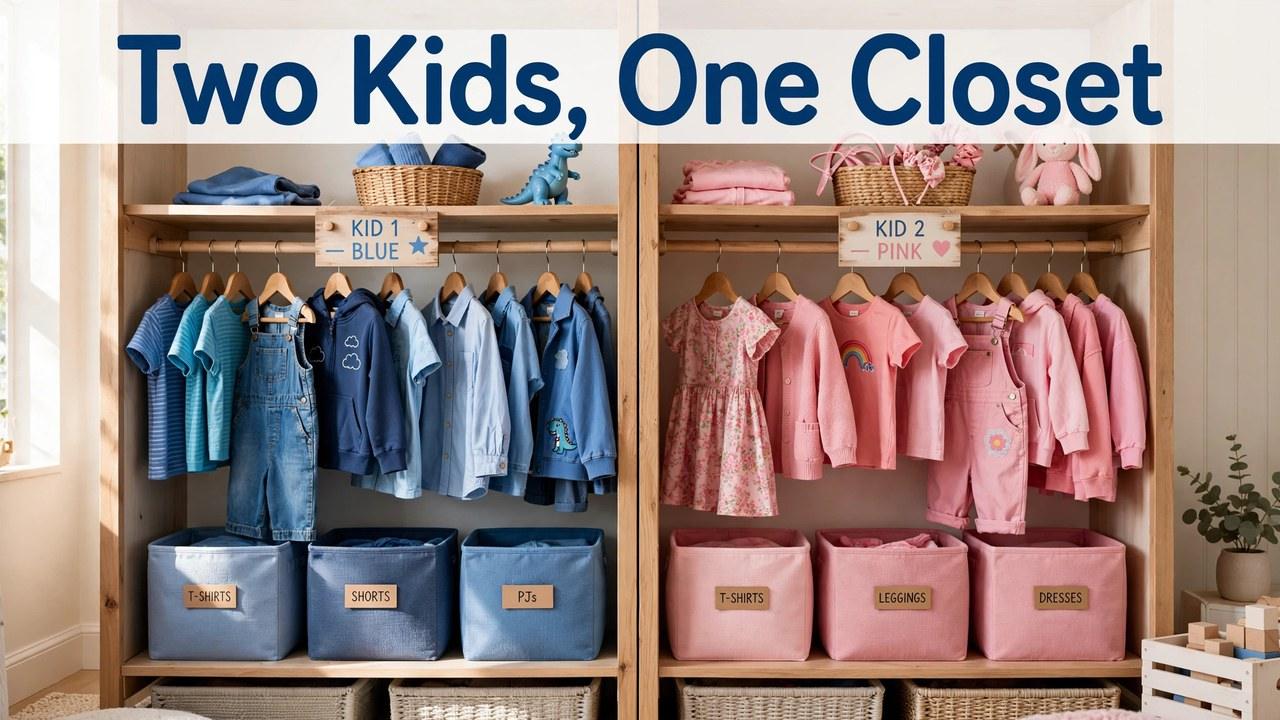
The vertical split (left half / right half) works when the kids are close in age and height. Each child gets a full-height column: their hanging rod section, their shelves, their floor space. It’s the fairest-looking arrangement, and fairness matters enormously to children.
The horizontal split (one rod high, one rod low) works when there’s a real age or height gap. The older or taller kid gets the upper rod, the younger gets the lower one. It doubles hanging capacity in the same width, which is the entire game in a small closet. The trade-off: the top kid’s long dresses or coats can dangle into the bottom kid’s space, so this split needs a strict “nothing below knee-length on the top rod” rule.
On pure capacity, the horizontal double-rod split wins — but only assign it if the younger child can actually reach their rod without a step stool they’d abandon by week two. A system a seven-year-old can’t use independently is a system the parent maintains forever.
Double Up the Rods Before You Buy Anything Else
A single closet rod wastes the bottom two-thirds of the space. A second tension or mounted rod at kid height instantly doubles hanging capacity for under fifteen dollars. Hang the current week’s school outfits on the lower rod where small hands can reach, and keep the out-of-season or dress-up clothes up high. If the closet is narrow, mount the rods front-to-back on opposite sides instead of spanning the full width — each kid gets a short double-rod column that feels like their own.
Give Each Kid a Color, Not a Lecture
Color-coding beats labeling for kids under ten, and honestly it beats labeling for teenagers too. One kid’s hangers are blue, the other’s are white. Their bins are different colors. Their shelf is marked with a colored tape stripe, not a name tag they’ll peel off. When everything belonging to one child is visually distinct, “put your stuff on your side” becomes a sorting game instead of a nagging session.
Zones Beat Sides
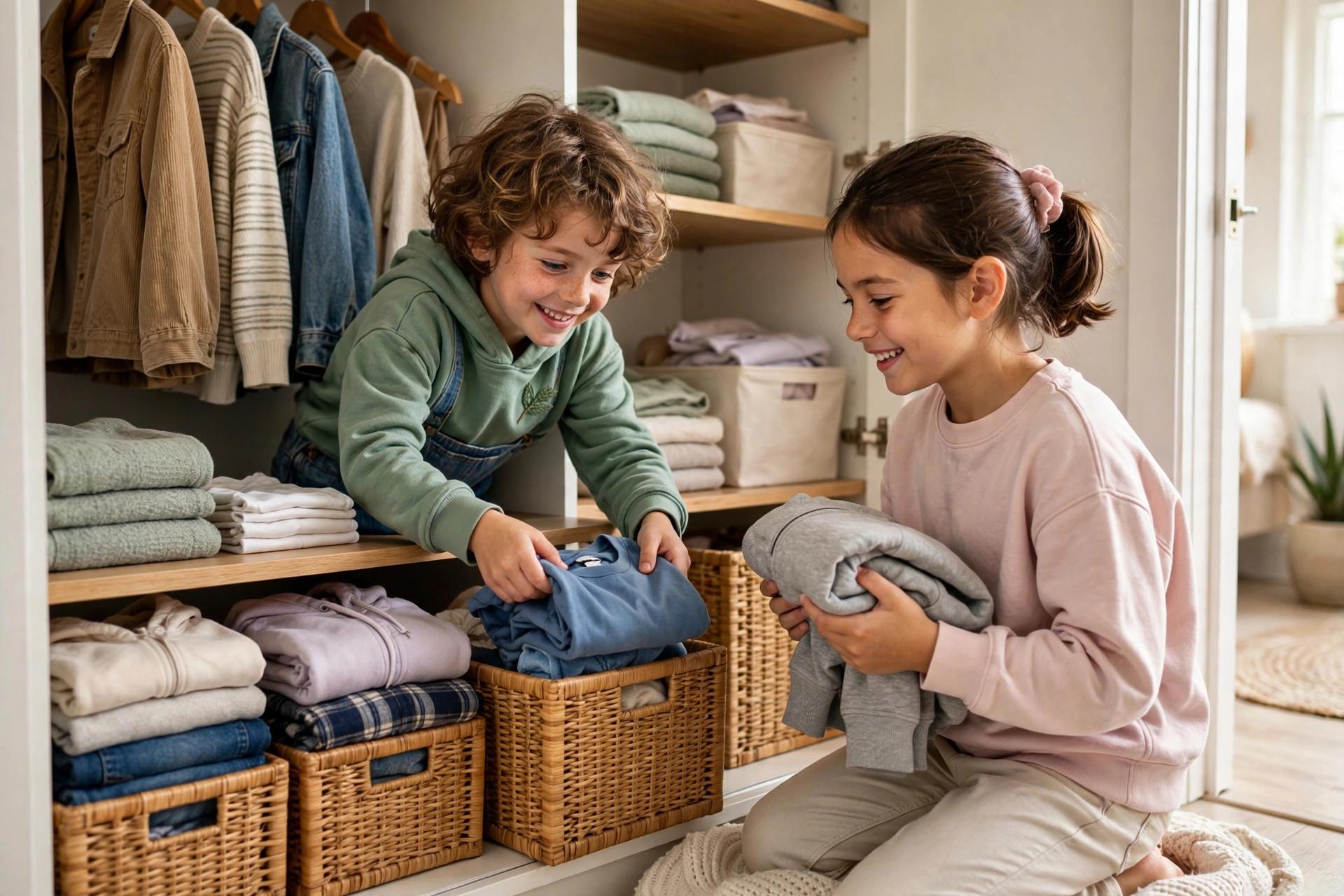
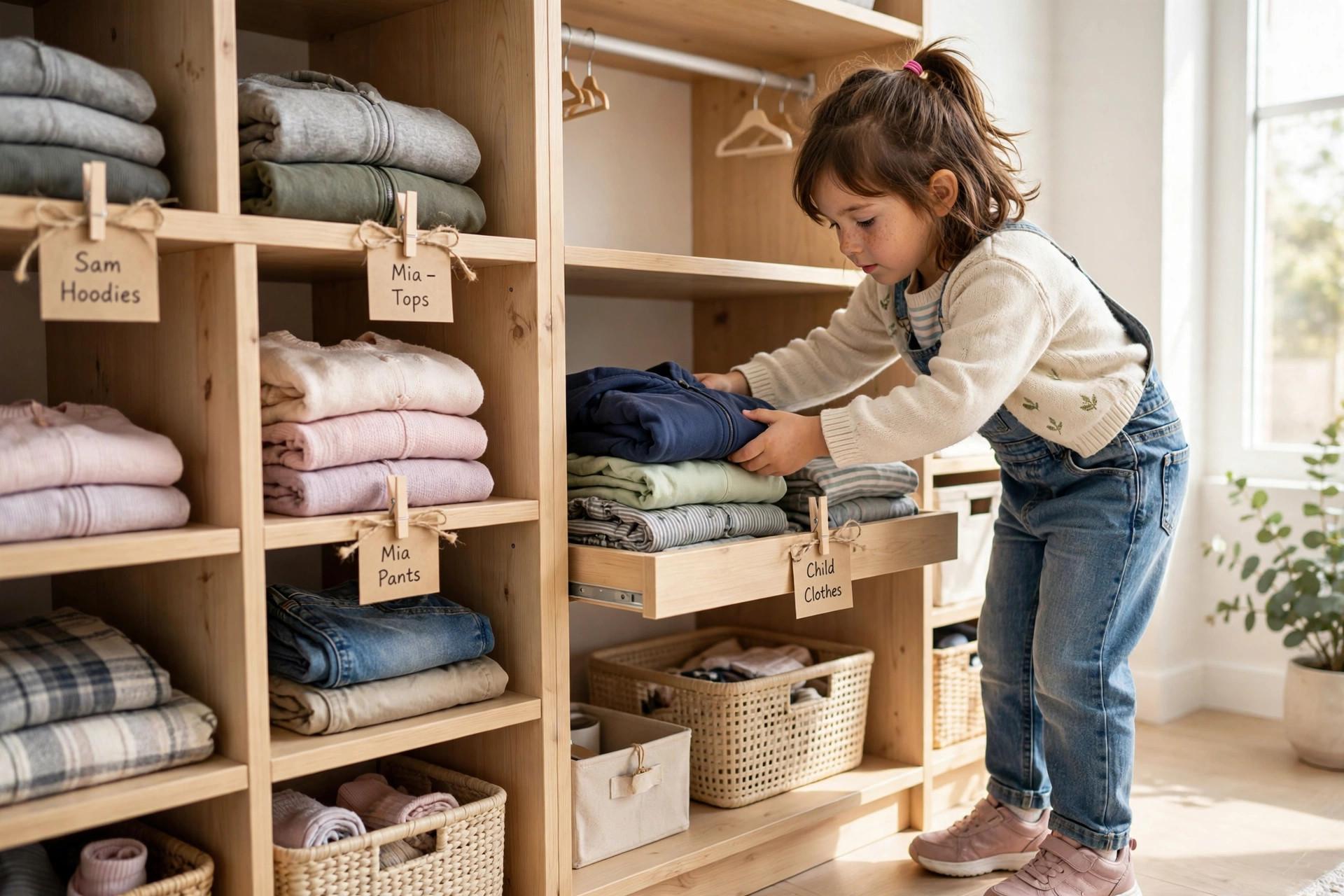
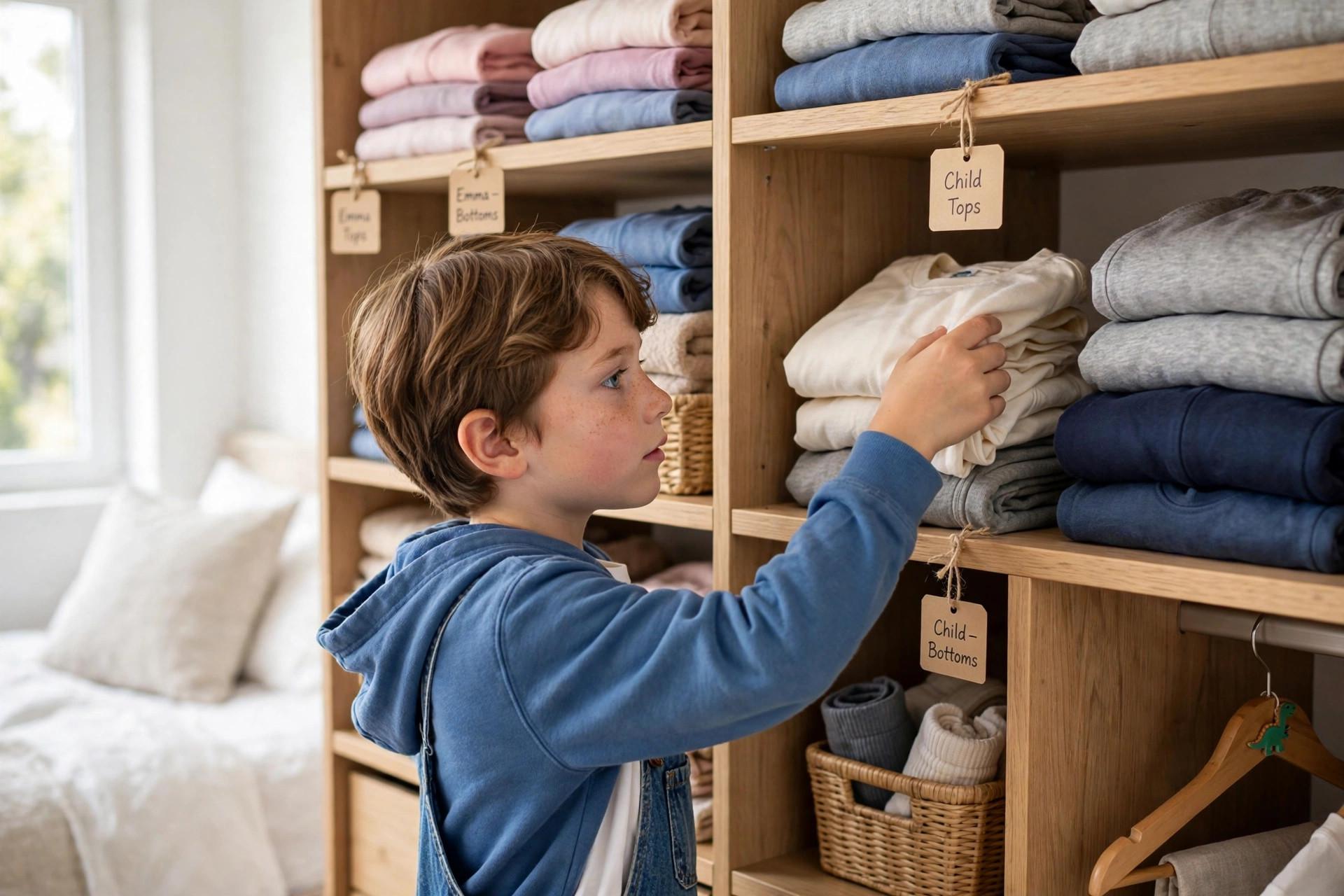
“Your side, my side” fails because sides are abstract and closets are three-dimensional. Zones are concrete: the left column is Maya’s hanging clothes, the top shelf is Maya’s bins, the floor bin on the left is Maya’s shoes. Walk each child through their zones once, physically pointing, and have them put three things away themselves. That ten-minute tour does more than any printed rule sheet. For the complete system behind these zones, see these kids small closet organization ideas that maximize every inch.
The Shoe Problem Needs Its Own Answer
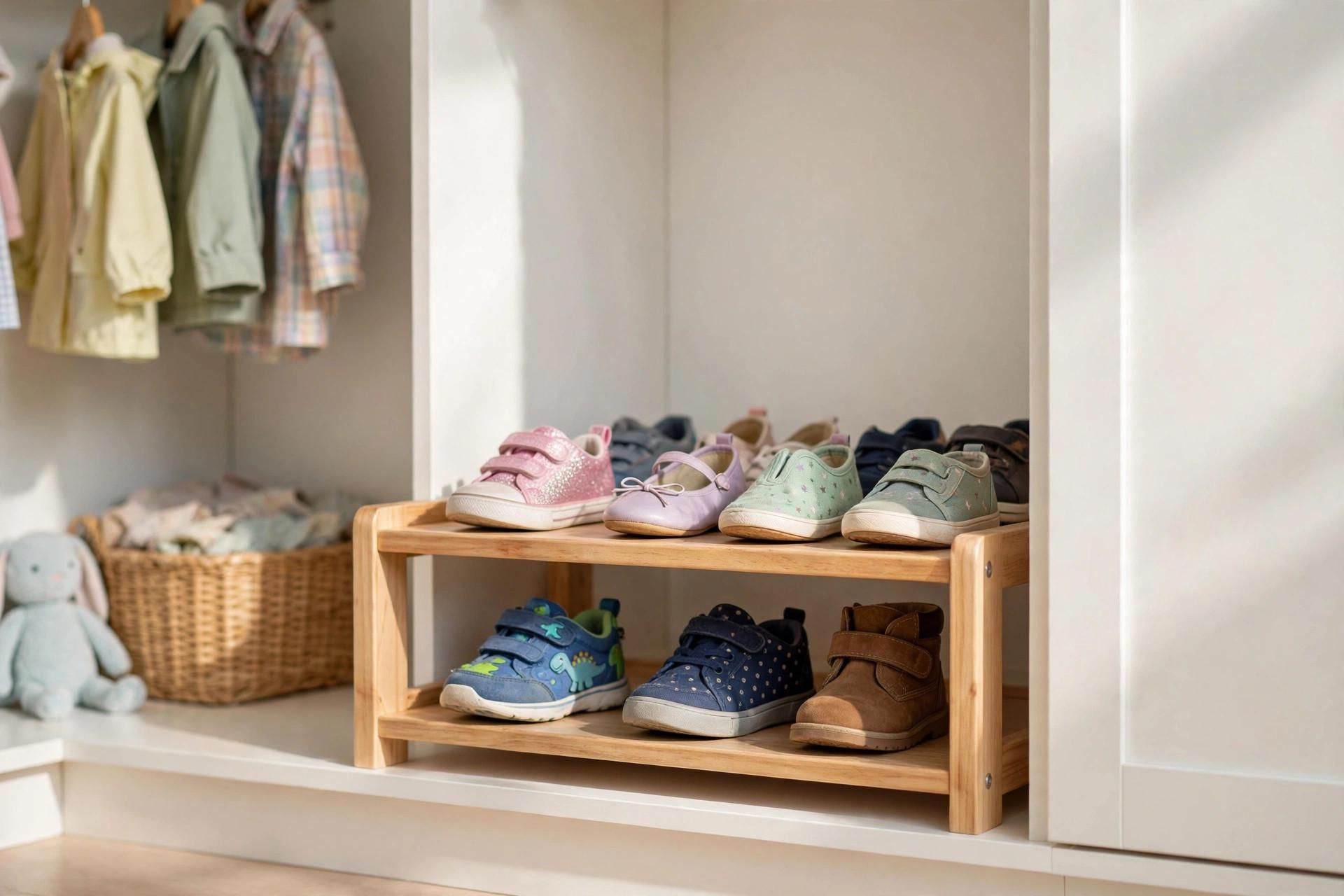
Shoes are what actually eat a shared closet. Two kids’ shoes on the floor turn the bottom twelve inches into a tangle neither child will touch. A low two-tier shoe rack — one tier per kid — or a pair of over-the-door shoe organizers (one per door, or split one) keeps footwear off the floor entirely. Cap it: each kid keeps five pairs in the closet, the rest live by the front door or in their room. The number is arbitrary; the cap is the point.
Build the Reset Into the Week
No shared closet stays organized without a reset, so stop hoping and schedule one. Sunday evening, five minutes, both kids: everything off the floor, hangers facing the right way, bins pushed back. Put on a song with a hard stop — when the music ends, the reset ends, done or not. Kids accept a bounded chore far better than an open-ended “clean your closet,” and a weekly five-minute reset prevents the monthly hour-long disaster.
What to Do When One Kid Is Just Messier
This is the part most guides skip. In most shared closets, one child maintains their zone and the other treats theirs as a laundry chute. The fix isn’t more rules — it’s containment. Give the messier kid the lidded bins and the closed lower shelves, where mess is invisible and contained. Give the tidier kid the open zones. You’re not rewarding or punishing; you’re designing around reality instead of fighting it.
The Seasonal Swap (Twice a Year, One Hour)
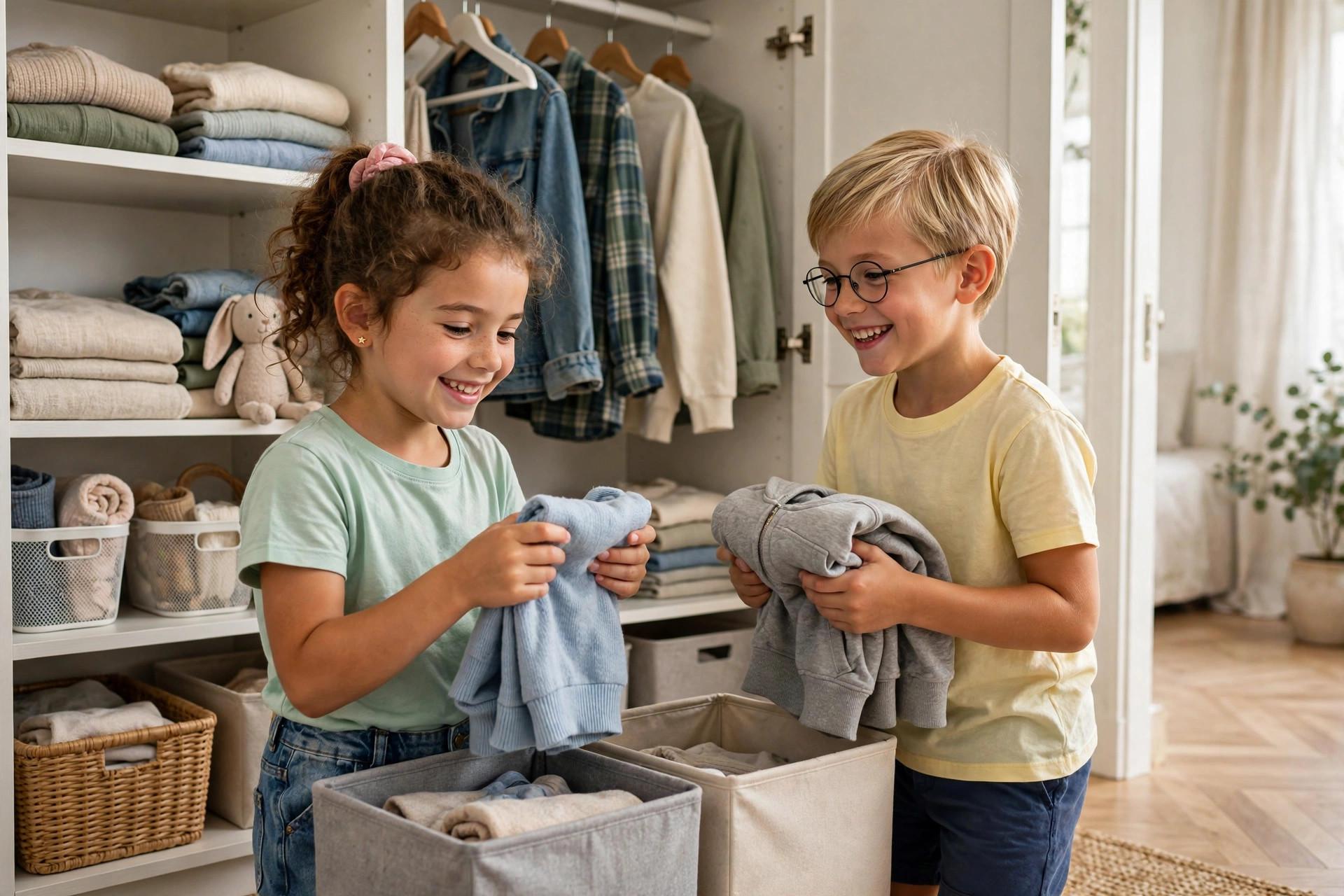
Every shared kids’ closet needs a pressure valve, and that’s the seasonal swap. Twice a year — when the weather genuinely turns — pull everything out together, move the off-season into labeled bins (one per kid, stored wherever the bins fit: under beds, top of the parents’ closet, garage shelf), and bring the current season in. Kids outgrow sizes at exactly the wrong moment, so the swap doubles as a size audit: anything that doesn’t fit goes straight to the donate bag, not back on a hanger “just in case.” The households that skip this are the ones where a February closet holds swimsuits and a size-6 jacket on a size-8 kid.
When the Closet Truly Isn’t Enough
Honesty matters here: sometimes the closet is just too small, and no zoning system fixes physics. The overflow hierarchy that works: first, move folded everyday clothes to a small dresser or stackable drawers in the room and reserve the closet for hanging items only. Second, under-bed bins for out-of-season and extras. Third — and only third — the hallway. What doesn’t work is buying a bigger “system” of organizers for the same forty inches; organizers subdivide space, they don’t create it. If you’ve zoned, capped, and reset and it’s still bursting, the answer is fewer items or a second location, not better bins.
A shared closet that survives the school year isn’t the prettiest one. It’s the one where each kid can find tomorrow’s outfit in the dark, put laundry in the right zone without thinking, and reset the whole thing in five minutes on a Sunday. Build for the tired Tuesday morning version of your kids, not the enthusiastic Saturday version, and the split will hold.
Use either a vertical split (left/right halves, best for similar ages) or a horizontal split (double rods, one high and one low, best with an age or height gap). Assign each child distinct zones — hanging section, shelf, and floor space — and color-code their hangers and bins so ownership is visual.
Make the division physical and obvious rather than rule-based: separate rods or columns, color-coded hangers, and labeled zones each child was walked through once. Most fights come from ambiguous boundaries, so remove the ambiguity and the arguments drop sharply.
Double the hanging rods to use vertical space, color-code one child’s items distinctly from the other’s, give shoes their own rack or door organizer off the floor, and run a five-minute Sunday reset. Keep each child’s daily outfits at their own reachable height.
Fewer than you think. A week’s worth of school outfits plus a few extras per child is plenty; out-of-season and occasion clothes belong in bins elsewhere. Overstuffing is the number-one killer of shared closet systems.
If you have the room, splitting folded clothes into two small dressers and reserving the closet for hanging items only is the lowest-conflict arrangement. But in a truly small room, a well-zoned shared closet with a strict item cap works fine.