
Low Thanksgiving Centerpieces for Small Tables That Keep Sight Lines Open
Here's the whole rule: nothing on the table rises above about twelve inches, and the entire centerpiece lifts off in one motion when the food arrives. Every low thanksgiving centerpiece small table idea in this guide follows from those two constraints — because on a small table, a centerpiece isn't decoration first. It's a negotiation with the turkey platter.
In apartments where the "dining room" is four feet of a living room, one lesson sticks: a centerpiece that blocks faces or fights the serving dishes isn't beautiful, it's in the way. Get the constraints right and the pretty part is easy.
Why does height matter more than how the centerpiece looks?
Because Thanksgiving dinner is a conversation with food in the middle, not a photo shoot. The moment someone has to lean sideways to see the person across from them, your centerpiece has failed at its actual job. Tall arrangements belong on entryway consoles and sideboards, where nobody needs to talk through them.
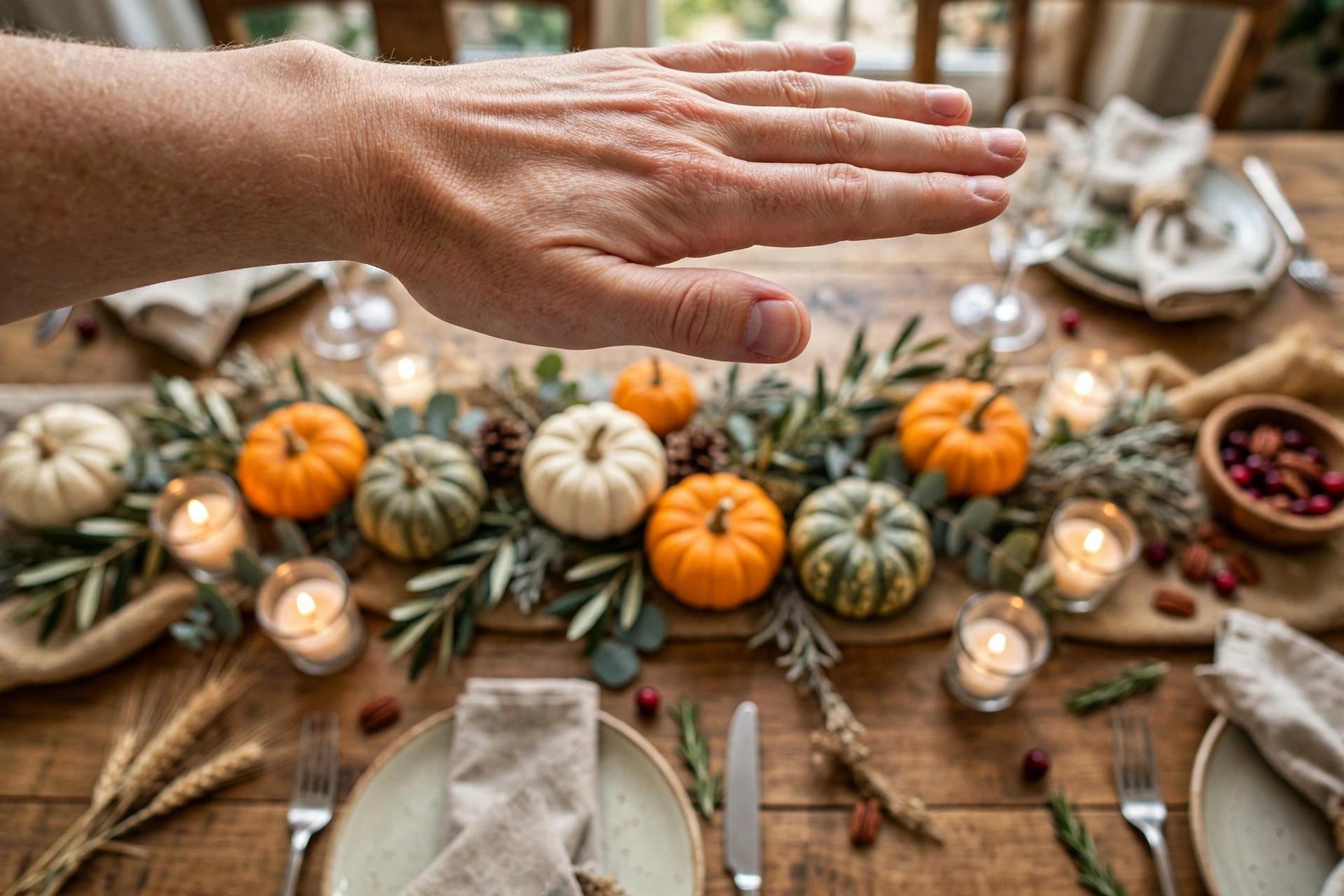
The twelve-inch rule is worth committing to memory. Sit in a chair at your table and hold your hand flat at about twelve inches above the tabletop — roughly the height of a wine bottle lying on its side, or a small pumpkin stacked on a book. Everything in your centerpiece should stay at or below that line. At that height you see every face, you can pass dishes over it without a relay system, and the table still looks dressed.
Test it the night before, not the day of. Sit in every chair — not just yours — and check sight lines across the diagonals too, since that's where the tall corner of an arrangement usually hides.
How much center space does a small table actually give you?
Less than you think, and this is where most centerpieces go wrong. A 36-inch round table seats four comfortably, and four place settings leave you a center circle of maybe twelve to fourteen inches. A 48-inch rectangle seating six gives you a center runway about ten to twelve inches wide once elbows and plates are accounted for.
So before you buy or build anything, measure the empty middle. Lay a tape measure across it. That number — not your ambition — is your footprint. On most small tables you're working with a strip or circle no bigger than a large serving platter, which is why the tray trick matters so much: build your centerpiece on or in a tray, and it becomes one movable object instead of five fragile ones.
What low Thanksgiving centerpiece layouts actually fit a small table?
Three layouts cover just about every small-table situation, and none of them needs arranging skill.
The runner row works on narrow rectangles. Line up a repeating sequence down the center: mini pumpkin, low votive, sprig of eucalyptus, repeat. Keep each element under your twelve-inch ceiling and leave gaps — the gaps are where serving dishes will land. It looks intentional because of the repetition, not because of any single fancy item.
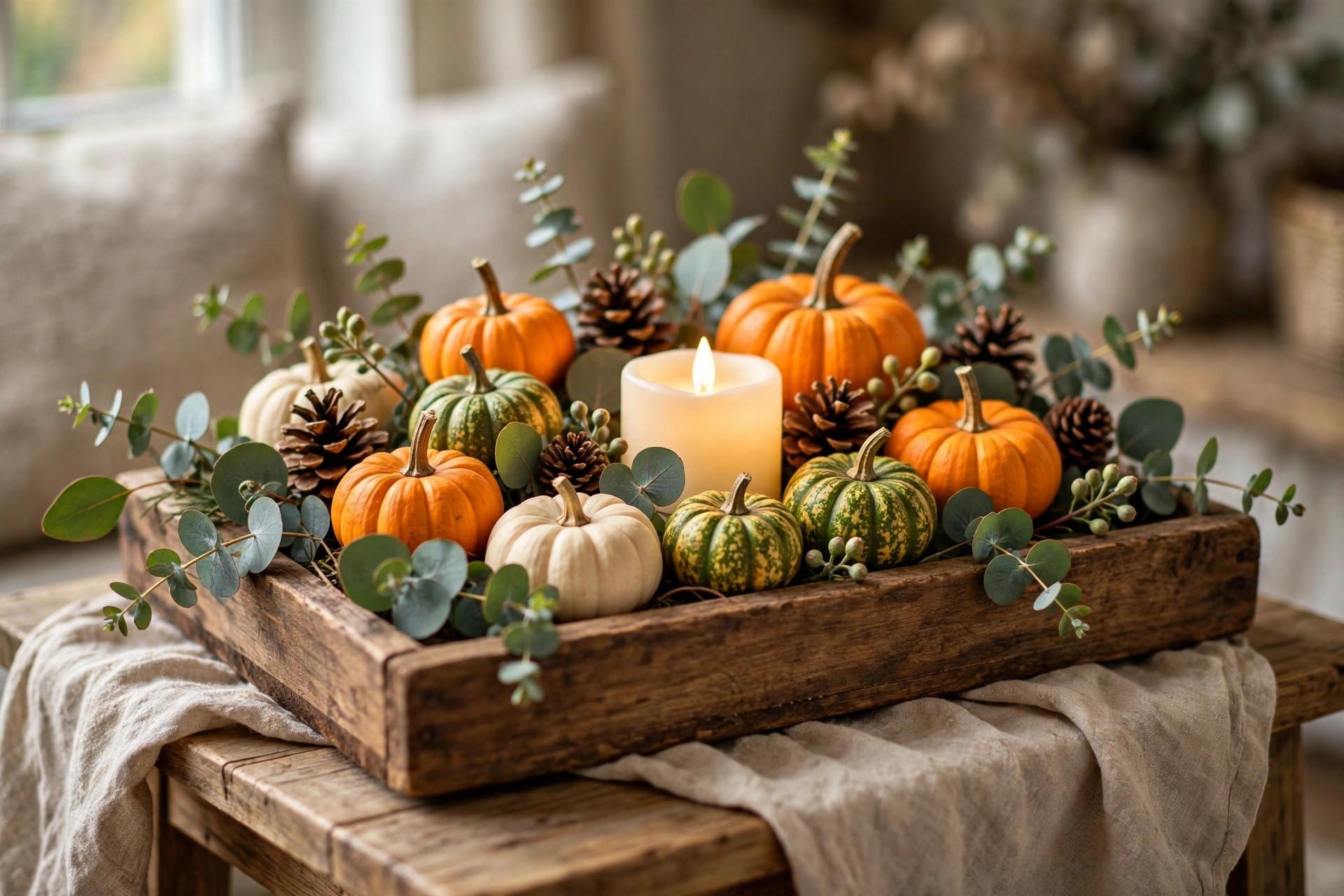
The tray cluster is the default for round tables. Take a wooden tray, a low basket, or even a rimmed baking sheet, and group three to five low items inside it: a couple of mini pumpkins, a short pillar candle, a handful of pinecones, a small bundle of eucalyptus tied with twine. When the turkey needs the space, you lift the whole tray with one hand and set it on the sideboard. Thirty seconds, no restyling required.
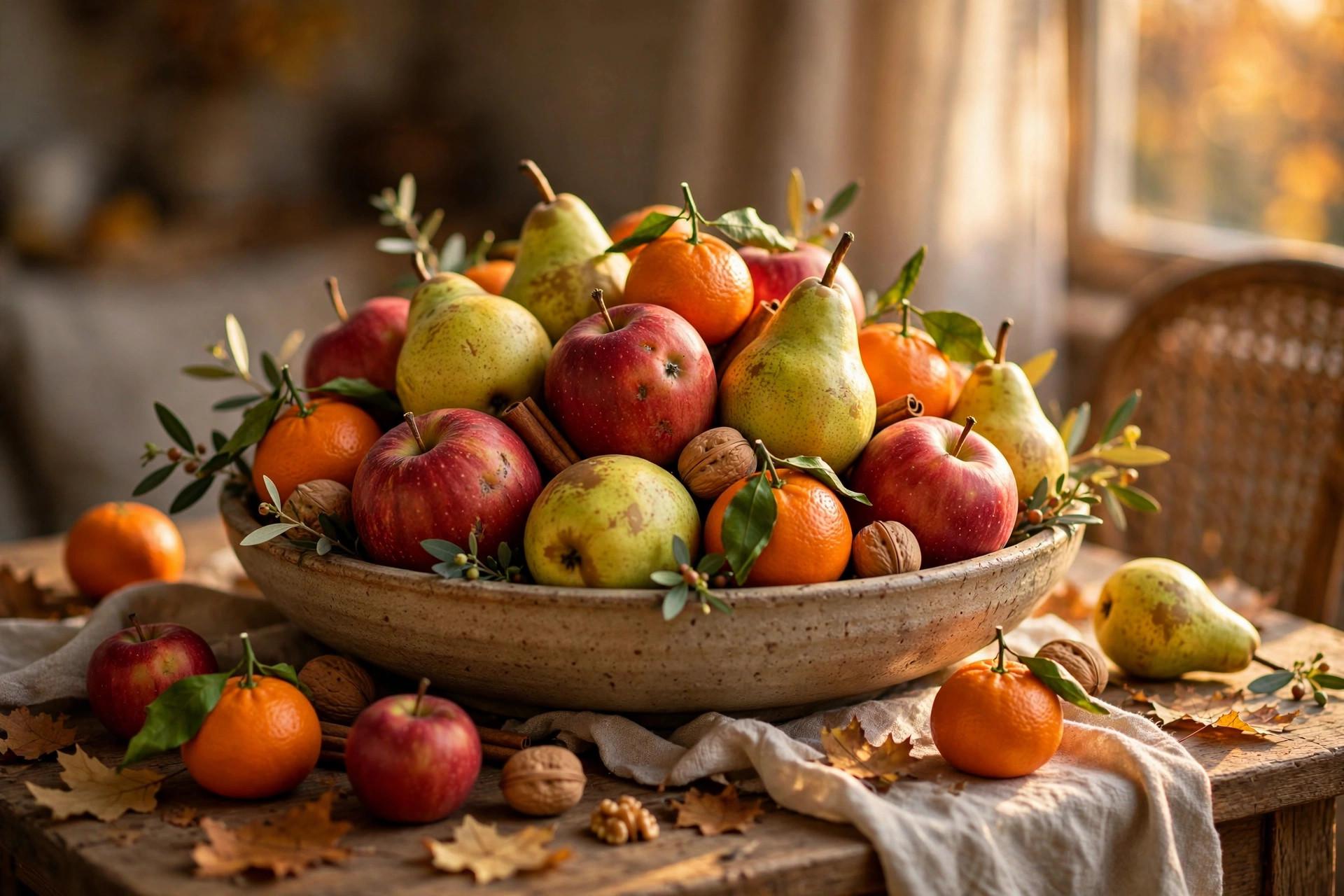
The edible center is the cleverest of the three. Fill a low, wide bowl with things people can actually eat: apples, pears, clementines, in-shell walnuts or chestnuts. It doubles as decoration and as the thing guests pick at while dinner finishes cooking. If anyone at your table has a nut allergy, skip the nuts entirely and lean on fruit — a bowl of clementines and apples looks just as abundant. For more harvest-bowl inspiration, our roasted veggie bowl ideas show how good simple produce looks when you let color do the work.
Are flameless candles worth it, or do they look cheap?
The genuine take: good LED pillars fool everyone at arm's length, and real flames near kids, loose sleeves, and a crowded small table are a bad trade. It's easy to insist on real candles only. One taper candle nearly going over into the stuffing when someone reached for the rolls is enough to convert anyone on the spot.
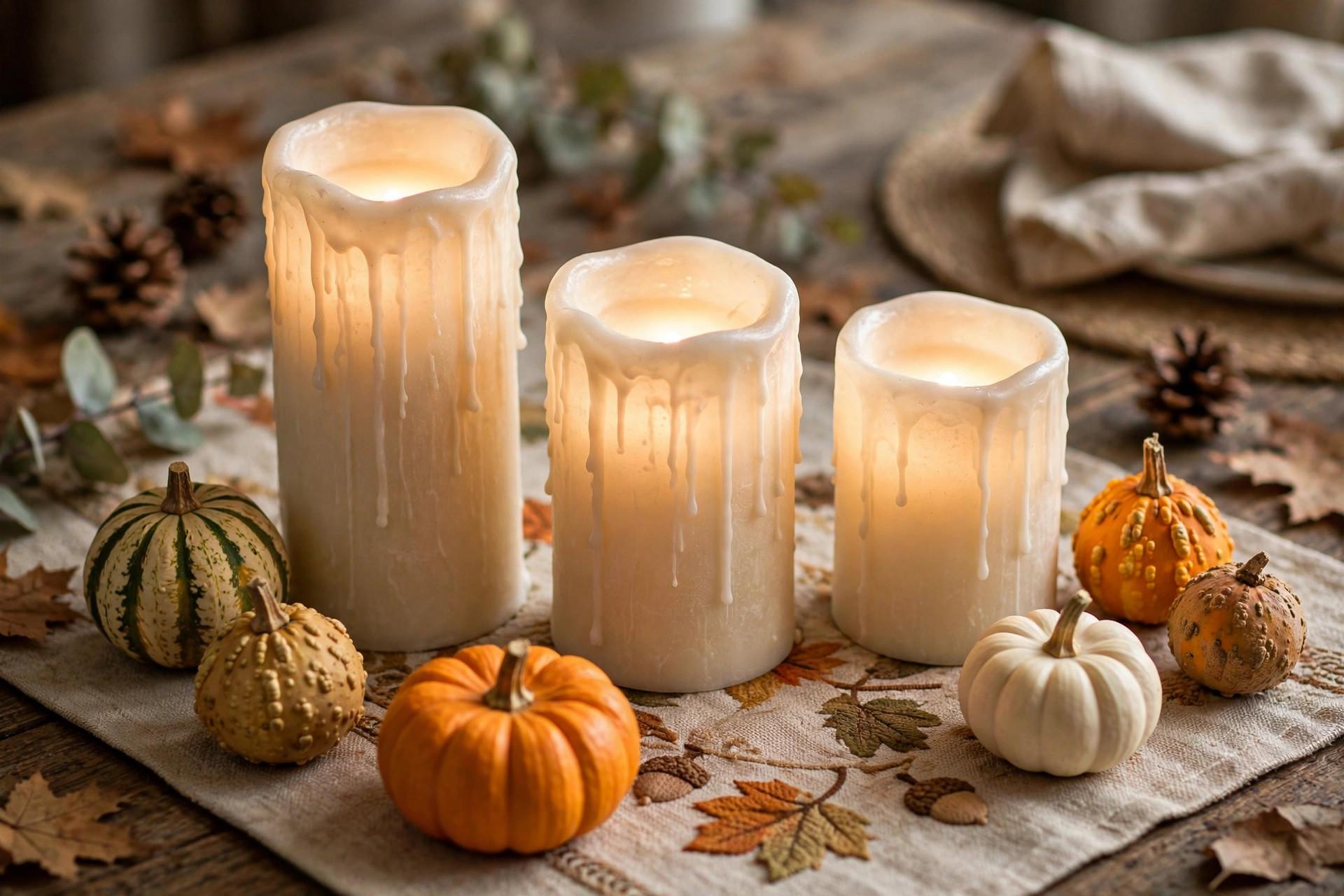
The trick is buying the right kind. Get LED pillars with real wax shells and a warm 2700K glow — not the bluish-white ones that scream "battery." At dinner-table distance, in dim light, nobody can tell. Fairy lights are the other good option: a string of warm-white micro lights loosely coiled in a mason jar or a glass lantern gives you sparkle at basically zero height, and there's no flame to worry about around a table full of elbows.
If you love real candlelight and your table has no kids and plenty of space, a couple of short, sturdy votives in glass holders are the safest way to do it. Keep them away from the table's edge and away from anything that sheds. But on a small table with a crowd? Flameless wins, and I'd rather have the peace of mind than the purist points.
What natural materials stay low without any arranging skill?
You don't need a florist's eye for a low centerpiece — you need a grocery store and restraint. Mini pumpkins and gourds are the obvious pick: they're already the right height, they come in great colors, and a five-dollar bag of them covers a whole table. Eucalyptus sprigs from the floral section lay flat, smell like the season, and don't wilt by dessert the way cut flowers do.
Citrus is underrated. A low bowl of clementines or halved oranges with a few cloves stuck in them looks abundant, smells wonderful, and costs almost nothing. Apples and pears work the same way. Pinecones are free if you have a tree nearby — just check them for sap and give them a shake outside first, because nobody wants sap on the tablecloth or a spider joining dinner.
One thing to skip: anything heavily scented that competes with the food. Strongly fragranced candles or lilies fighting the turkey smell is a rookie mistake. Eucalyptus and citrus are scented, yes, but they're food-adjacent scents — they belong at a dinner table in a way that a vanilla-bomb candle doesn't.
What should you avoid on a small Thanksgiving table?
A short list of things that look great on Pinterest and cause problems in real dining rooms. Tall vases and candelabras — they break the twelve-inch rule on purpose and turn conversation into a game of peek-a-boo. Open flames near kids or anywhere sleeves and serving dishes are in motion. Shedding garlands: pine needles and glitter in the gravy are not festive, they're a cleanup project.
Anything you can't move with one hand is a liability. The turkey platter always needs more room than you planned for — it just does — and a centerpiece that requires disassembly to make space will either get shoved aside carelessly or cause a traffic jam at the worst moment. And skip the overly precious items: the heirloom ceramic turkey your aunt will worry about all dinner isn't a centerpiece, it's a source of anxiety. Save it for the sideboard where it can be admired without risk.
Should you use a tablecloth or runner under a low centerpiece?
It depends on the table, and it's worth deciding before you build anything. A runner under a low centerpiece is almost always a win on a small table — it visually connects scattered elements into one deliberate arrangement, and it protects the wood from candle wax and pumpkin stems. Burlap, linen, or even a strip of that same kraft paper from the kids' table (folded in thirds, torn edges and all) works; the casual texture suits the low, abundant style.
A full tablecloth on a small table is a judgment call. It dresses up a folding table beautifully, but it also eats into your already-tight footprint — cloth bunches where a runner lies flat, and overhang eats knee room. The rule: a folding or beat-up table gets a cloth; a wood table you're proud of gets a runner or nothing. Either way, decide first, because building a centerpiece and then discovering the cloth changes your height math is an annoying do-over.
What's the one trade-off worth making?
If I had to choose between a centerpiece that's stunning and one I can clear in thirty seconds, I take the clearable one every time. Dinner comes first; the table is a tool for eating together, and anything that gets in the way of that has its priorities backwards. This is the opinion most decor guides won't give you because it doesn't photograph as well — but nobody remembers the centerpiece that stayed perfect. They remember the dinner that felt easy.
The related trade-off: eucalyptus over fresh flowers, every year. Flowers are prettier for about four hours, then they wilt, drop petals into the food, and cost five times as much. Eucalyptus looks good from setup through leftovers, costs a few dollars, and you can compost it or hang it in the shower when dinner's over. The flower budget is better spent on one good set of wax-shell LED pillars, reusable every November. Buy once, look good for a decade.
Our fall decor crossover helps here too — if you decorated for Halloween, our 13 Halloween decor ideas post probably left you with mini pumpkins and gourds already in the house. Reuse them; nobody will know they did double duty. And if your small table lives in a dining corner of the living room, our interior ideas for living rooms have a few tricks for making that corner feel intentional rather than improvised.
Set it up the night before. Sit in every chair, check every face, then put the food down and enjoy it — that's the whole next step, and honestly the whole point.
Hosting a smaller crowd this season? These cozy fall dinner party themes for small groups turn an intimate table into the main event.
Keep everything at or below about twelve inches so guests can see each other’s faces across the table. Sit in every chair the night before and check sight lines, including the diagonals.
Flameless LED pillars with wax shells are the safer choice — they look convincing at table distance and there’s no flame near sleeves and elbows. If you use real candles, stick to short, sturdy votives in glass holders, away from the table’s edge.
Mini pumpkins, eucalyptus sprigs, clementines or apples in a low bowl, pinecones, and in-shell nuts (skip nuts if anyone has an allergy). They stay low naturally, cost little, and don’t wilt by dessert.
Build the centerpiece on a tray so it lifts off in one motion when serving dishes arrive, and leave gaps in a runner-style layout for platters. Move overflow serving dishes to a sideboard rather than crowding the table.
Design it so it doesn’t have to — food comes first. A tray-based or low runner-style centerpiece can stay for part of the meal and move to the sideboard in seconds when the turkey platter needs the room.